
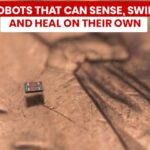
After nearly 40 years of trying, researchers have finally solved one of engineering’s toughest challenges. Teams from the University of Michigan and the University of Pennsylvania have created a robot smaller than a grain of salt that can sense, think, and act on its own. It may sound like science fiction, but this breakthrough is happening in real labs. A robot you can barely see Each robot is incredibly tiny, about 0.2 x 0.3 x 0.05 millimetres. That’s roughly the size of microscopic living organisms. Despite being so small, these robots can move on their own, sense their surroundings, and respond to changes. Even more surprising, they cost around one cent each to make. Powered and controlled by light Unlike earlier tiny machines, these robots don’t use wires, magnets, or remote controls. Instead, they are powered and programmed using light pulses. Each robot also has its own unique ID, which means scientists can control them individually. Inside every robot is a tiny “brain” developed at the University of Michigan. This micro-computer allows the robot to sense things like temperature and change how it moves based on what it detects. Why this is a big deal For decades, scientists believed it was almost impossible to build robots smaller than one millimetre that could work independently. While phones and chips kept shrinking, robots couldn’t keep up. According to lead researcher Marc Miskin, this invention opens up a whole new size range for robotics that was once thought unreachable. How these robots could change medicine In the future, these tiny robots could completely transform healthcare. Researchers believe they may one day be able to: The best part? This isn’t a far-off dream. Scientists believe real medical uses could appear within the next 10 years. Still in the lab for now There are limits at the moment. These robots need upgrades to safely work inside the human body. They also currently function in freshwater, not saltwater or dry environments. Still, the tech is surprisingly accessible even high school students have operated them using a $10 microscope. What comes next The next goal is to make swarms of robots that can communicate and work together. This could one day change how surgeries are done. Some experts even imagine robots replacing surgeons in the distant future. From sci-fi to reality Compared to early robots like MIT’s 1989 “Squirt,” these new machines are 100 times smaller and far more capable, running on light like tiny solar-powered brains. This moment marks a turning point microscopic robots are no longer just an idea. They’re real, and they’re here.
The post appeared first on .