
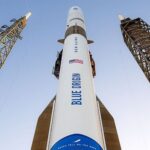
Blue Origin has officially sent NASA’s long-awaited EscaPADE mission on its journey to Mars, creating a historic moment for the company and pushing humanity one step closer to deeper space exploration. A long-awaited liftoff After several delays caused by cloudy skies and a powerful solar storm, Blue Origin’s New Glenn rocket finally lifted off from Launch Complex 36 at Cape Canaveral Space Force Station. The two-stage rocket standing as tall as a 32-story building powered into the sky with the help of seven BE-4 engines, burning more than 2,800 pounds (1,270 kg) of liquid fuel every second. This is Blue Origin’s first mission since New Glenn’s debut test flight on January 16, and the successful liftoff marks a major comeback. A dramatic rise into space A live webcast captured the rocket’s powerful ascent, showing huge plumes of fire and smoke trailing behind as it roared off the pad. This launch only happened after multiple weather-related delays, including a strong geomagnetic storm that forced teams to push back the schedule. If everything works as planned, New Glenn’s reusable first stage will separate and attempt a landing on an ocean barge a maneuver that previously failed in January due to an engine issue. The mission: Understanding Mars like never before The main purpose of this launch is NASA’s dual-spacecraft mission called EscaPADE, short for Escape and Plasma Acceleration and Dynamics Explorers. These two satellites, nicknamed Blue and Gold are designed to travel together and study: Around 30 minutes after launch, the satellites will be released from the rocket’s upper stage. From there, they will begin a 22-month journey to Mars.Once they reach the Red Planet, the duo will spend 11 months orbiting Mars in sync, gathering detailed data on space weather. A delayed mission back on track EscaPADE was originally supposed to launch in October 2024, but delays in New Glenn’s development pushed the mission more than a year behind schedule. During New Glenn’s first test flight in January, the rocket carried Blue Origin’s own experimental payload called Blue Ring, a prototype spacecraft for defense and commercial customers. The EscaPADE satellites were built by Rocket Lab, while mission instruments came from the University of California, Berkeley. Why this launch matters for Blue Origin Founded by Jeff Bezos in 2000, Blue Origin has mostly been known for its New Shepard suborbital rocket, which takes tourists briefly to space and has carried over 200 scientific experiments.But this mission marks something much bigger: For comparison: NASA paid about $55 million for the EscaPADE mission and $18 million to Blue Origin for the New Glenn launch relatively low costs compared to other large NASA projects. Blue Origin’s bigger space vision The company isn’t stopping with this mission. Blue Origin also: Even so, it still has a long way to go to catch SpaceX, which is also developing Starship, the world’s most powerful fully reusable rocket designed for Moon, Mars, and deep-space missions. With the EscaPADE launch, Blue Origin has proved it can deliver major science missions not just space tourism flights.If the spacecraft reach Mars successfully, the mission could reveal groundbreaking insights into the planet’s atmosphere and its long-term evolution.
The post appeared first on .