
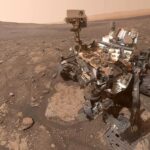
NASA’s Curiosity rover has made an exciting discovery on Mars by detecting several organic compounds never seen on the planet before. These findings come from a unique experiment that scientists had never attempted outside Earth until now. The discovery is helping researchers better understand whether Mars may once have supported life. What exactly did scientists find? Curiosity identified seven different organic compounds in rock that formed in an ancient dried lakebed near Mars’ equator. Out of these, five compounds had never previously been detected on Mars. The experiment also hinted at another compound with a structure similar to DNA building blocks the molecules that carry genetic information in living organisms on Earth. Organic compounds are carbon-based molecules that form the foundation of life as we know it. However, scientists clarified that these compounds do not prove life existed on Mars, since they can also form through natural chemical reactions without biology. Why this discovery matters Mars formed around 4.5 billion years ago, roughly the same time as Earth. Scientists believe early Mars was once warmer, wetter, and more suitable for life than the cold, dry planet we see today. The rock studied by Curiosity is at least 3.5 billion years old and was formed from sediments carried by flowing water. This suggests Mars once had environments where life could have survived. Astrobiologist Amy Williams from the University of Florida explained that while there is still no direct evidence of past life, the findings strengthen the idea that Mars may once have been habitable especially around the same time life began on Earth. Where the rover made the discovery? Curiosity landed in Gale Crater in 2012, an area created by an ancient impact. The rover performed this experiment in Glen Torridon, a region rich in clay minerals. Clay is important because it can preserve organic molecules better than most other minerals. If microbial life ever existed on Mars, scientists believe lakes and water-rich areas like this would have been ideal habitats. How the experiment worked The rover used its Sample Analysis at Mars (SAM) instrument to study a rock sample drilled at a site called “Mary Anning,” named after a famous 19th-century fossil hunter. The powdered rock was mixed with a special chemical that broke large organic materials into smaller detectable pieces. This helped scientists identify new types of molecules never previously observed on Mars. Researchers also confirmed the presence of macromolecular carbon, a larger and more complex form of organic material. Surprisingly, these compounds have remained preserved near the Martian surface despite exposure to harsh radiation for billions of years. What happens next? Scientists say the strongest proof of past life on Mars would require bringing rock samples back to Earth for deeper testing. Until then, discoveries like this continue to reveal that Mars once had many of the basic ingredients needed for life.
The post appeared first on .