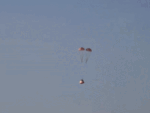
A major success has been achieved in the preparation of India’s first human space mission Gaganyaan. ISRO successfully completed the second Integrated Air Drop Test (IADT-1) on Thursday. This test was conducted to examine the parachute system prepared for the Gaganyaan mission under real conditions. Its purpose was to check the parachute deployment process before the Gaganyaan mission. This process will ensure the safe return of astronauts during the mission. During the test, a dummy crew capsule weighing approximately 5.7 tons was dropped from an Air Force Chinook helicopter from a height of 3 km. The capsule made a safe landing in the sea. This is the second air drop test of the crew capsule in the last 8 months. The first test was conducted on August 24, 2025. Gaganyaan Mission: Pilots including Shubhanshu will go to space in 2027 Gaganyaan is ISRO’s human space mission. Under this, three Air Force pilots will be sent to space via spacecraft in 2027. These pilots will stay in a 400 km orbit for 3 days, after which the spacecraft will be landed in the Indian Ocean. The cost of the mission is approximately 20,193 crore rupees. Four Air Force pilots have been selected for the Gaganyaan mission so far, one of whom is Group Captain Shubhanshu Shukla. This is why Shubhanshu went to the International Space Station under the Axiom mission. Before sending pilots to space through Gaganyaan, ISRO will send two empty test flights. A robot will be sent in the third flight. After its success, humans will be able to go to space in the fourth flight. The first test flight may be sent by the end of this year. Shubhanshu Shukla has stayed at ISS for 18 days Shubhanshu Shukla returned safely to Earth on July 15, 2025, after staying at the International Space Station (ISS) for 18 days under the Axiom-4 mission. After that, he reached India on August 17. PM Modi met him on August 18. This meeting lasted about 20 minutes. What preparations has ISRO completed for the ‘Gaganyaan Mission’ and what remains The Gaganyaan mission rocket is ready and astronaut training is ongoing… 1. Launch Vehicle Ready: The HLVM3 rocket launch vehicle capable of taking humans to space has been prepared. Its security testing has been completed. This rocket was previously known as GSLV Mk III, which has been upgraded. 2. Astronaut Selection and Training: Under the Gaganyaan mission, 3 astronauts will be taken to space. For this, 4 pilots from the Air Force have been selected. Their training has been completed in India and Russia. They have been given training through simulators. Other training related to space and medical aspects is being provided. 3. Crew Module and Service Module: The crew module where astronauts will sit and the service module containing power, propulsion, and life support systems are in their final stage. Their testing and integration remain pending. 4. Crew Escape System (CES): A crew escape system has been prepared to immediately separate the crew module from the rocket in case of any mishap during launch. Five types of crew escape system solid motors have been built, which have also been successfully tested. 5. Recovery Testing: ISRO and the Navy have conducted testing for the safe return of the crew module after splashdown in the Arabian Sea. An agreement has also been made with Australia for backup recovery. 6. Robot for Unmanned Mission: In January 2020, ISRO announced that a humanoid has been created for Gaganyaan’s unmanned mission, named Vyommitra. Vyommitra has been prepared to conduct experiments in microgravity and test the module. After 41 years, an Indian went to space Under an agreement between American space agency NASA and Indian agency ISRO, Indian Air Force Group Captain Shubhanshu Shukla was selected for Axiom Mission-4. Shubhanshu is the first Indian to go to the International Space Station and the second Indian to go to space. 41 years before this, Rakesh Sharma had traveled to space in 1984 on a Soviet Union spacecraft.
The post appeared first on .