
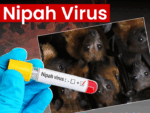
The World Health Organisation (WHO) issued a statement on Thursday saying that the risk of the Nipah virus spreading ‘remains low’ after two cases were reported in India. It further stated that, as far as the current situation is concerned, there is no need to impose travel or trade restrictions. The statement came after two cases of the Nipah Virus were detected in West Bengal in December 2025, which has raised concern due to its high fatality rate of 40–75%. In response, several Asian countries such as Thailand, Malaysia, and Singapore had introduced new screening and testing measures. But what exactly is the Nipah virus, and how serious the threat could be? What is Nipah Virus? WHO defines Nipah Virus as zoonotic, meaning it can spread from animals to humans. It was first identified during a 1998 outbreak in Malaysian pig farms that killed over 100 people. Since then it has caused recurrent outbreaks in Bangladesh and India, often linked to bat habitats. It has limited but dangerous human-to-human transmission via close contact, earning it WHO priority status as a potential pandemic threat. Nipah Virus belongs to a category of viruses called henipaviruses. How Does It Spread? There are three major ways it is transmitted- Symptoms and Severity Symptoms typically appear 3-14 days after exposure. In severe cases, the infection can worsen quickly, leading to pneumonia, brain inflammation (encephalitis), seizures, coma and breathing problems making the virus deadly. Even those who recover may face long-term effects, such as brain inflammation years later or permanent nerve damage, including personality changes or paralysis. Unlike COVID-19, Nipah mainly affects the brain, and outbreaks rarely involve mild cases, which adds to its high fatality rate. Cases of Nipah Virus in India India has so far confirmed two Nipah virus cases in West Bengal’s North 24 Parganas district in January 2026. Both patients are 25-year-old nurses at a private hospital in Barasat. They fell ill in late December 2025 with symptoms progressing to severe neurological issues. One recovered while the other remains critical. Authorities have traced and tested 196 contacts and kept them under monitoring. All tested negative and showed no symptoms. No new cases have been reported since 27 January 2026. Officials have declared the outbreak contained, with a national response team continuing surveillance and investigations. Treatment status and vaccines According to WHO currently, there is no licensed vaccine or specific treatment for Nipah virus infection, although several candidates are under development. Early supportive care, including intensive care for severe respiratory or neurological complications, remains critical for improving survival. Global Response and Risk Assessment WHO’s stance against travel and trade restrictions reflects Nipah’s limited human-to-human transmission, unlike airborne viruses. Airport officials across Thailand, Malaysia, Singapore, and other Asian nations rolled out thermal scans and questionnaires for passengers from West Bengal. The WHO lists Nipah as a priority pathogen for its high fatality and transmission risks. Previous outbreaks stayed small and local, with low human-to-human transmission. Previous outbreaks of Nepah Virus Since 1998, the Nipah virus has infected over 700 people across South and Southeast Asia, mostly in small clusters. In Bangladesh, outbreaks occur almost every year, often linked to drinking raw date palm sap.
The post appeared first on .