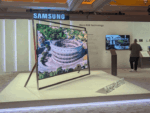
Before the start of the world’s largest tech show, CES 2026, Samsung unveiled the world’s largest 130-inch Micro RGB TV in Las Vegas. Its size is so large that the company has also provided a large metal stand to support it. The special thing is that with the help of this stand, the screen can also be tilted slightly. This design is reminiscent of Samsung’s 2013 ‘Timeless Gallery’ stand.
However, the company has clarified that this is currently a ‘concept’ model, meaning it will not be launched in the market yet. OLED-like clarity and better brightness This Samsung TV is an advanced form of mini LED technology. It has very high accuracy in colors and contrast. It displays colors deeper and more naturally. This TV can also be mounted directly on the wall, but its special stand will also have to be mounted on the wall because the TV’s speaker system is integrated within that stand. AI will make even blurry pictures bright Samsung has used the ‘Micro RGB AI Engine Pro’ processor in this TV. The ‘Color Booster Pro’ and ‘HDR Pro’ technologies present in it improve dull colors with the help of AI. It clearly shows the subtle differences between dark and bright scenes. The TV screen is also ‘glare-free’. This means there is no light reflection (glare) on it. Microsoft Co-pilot and Vision AI support for search This TV not only offers good picture quality but also comes with a host of smart features. Estimated price in millions If this TV comes to the market, its price will be very high. Last year, Samsung introduced a 115-inch model, which was priced at around ₹25 lakh. Difference between Micro RGB and Micro LED Micro RGB is essentially an improved Mini LED, while Micro LED is a completely different and expensive technology that uses self-illuminating pixels like OLED. Micro RGB is for those who need a very large screen and brightness. Samsung to include AI in all home appliances
Along with this TV, Samsung has announced the inclusion of AI in all its home appliances, like refrigerators and washing machines. The company is now integrating AI not only in smartphones but also in smart homes and consumer electronics.
The post appeared first on .